
8-bit Coding for everybody: WUDSN IDE Video Tutorial online
category: code [glöplog]
@Cefa68000: I you are a real 8-bit coder, it's not hard because that's that was you learnt it. You don't even count the "circles", you just type them in mixed with some other characters to get the best possible result.

Sweet link Wood, i have several mags they are missing issues of also.

i guess you meant cycles, not circles!

hArDy./tRSi Yep bad typo. But it would help if you had that functionality when you are a newbie like me. Having to look up if this instruction takes 2 cycles or 1 and other stuff just takes unnecessary long time in the beginning. Or maybe i am just lazy :)

you are lazy!
once you know how many cycles what needs you can plan effects wherever you are ;)
so while at the supermarket, which is sth you do automatically, you can think of new Effects and calc if its possible in 50Hz meanwhile ;)
once you know how many cycles what needs you can plan effects wherever you are ;)
so while at the supermarket, which is sth you do automatically, you can think of new Effects and calc if its possible in 50Hz meanwhile ;)
first thing to do for a coder would be to test how many cycles one add-instruction takes, and if this gets lesser in a big loop of lets say 240 times...
...then try the same with other instructions!
with a CPU having at ~1MHz its easy to count ;)
...then try the same with other instructions!
with a CPU having at ~1MHz its easy to count ;)
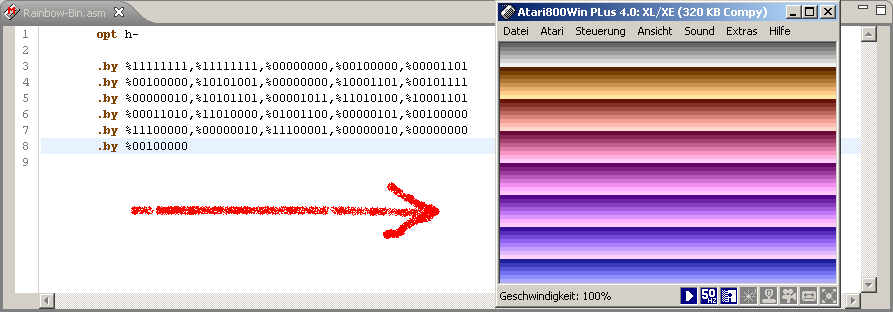
Haha. Sorry. I really tried to make sense out of the post - and came to the conclusion that it's another April fool. Cycles is of course a nice idea and were on my list originally but I found that the possibility to load the labels into the emulator (currently MADS/Altirra, ATASM/Atari800Win are supported, other can be added on request) is much more useful and accurate. I take taken branches, crossed page boundaries a.s.o. into account.

But of course having an overview of all opcodes with their hex values and cycles make absolutely sense. I'll try and ask the Oxyron guys so I can include their overview. It's the one I'm using all the time.
But of course having an overview of all opcodes with their hex values and cycles make absolutely sense. I'll try and ask the Oxyron guys so I can include their overview. It's the one I'm using all the time.
looks promising

hehe, yes, forgot about a short time whom i am trying to fool ;)
thanx again for all your Efforts, would be too cool to have it all in one, one Day ;) all the 8bits, maybe some 16bits and even vectrex! i´d use it for sure! AND: everyone complaining...Eclipse aint any bad, its just different, but once you know how to handle it you may even think of moving completely! doesnt apply to winCode c# /.net maybe!
thanx again for all your Efforts, would be too cool to have it all in one, one Day ;) all the 8bits, maybe some 16bits and even vectrex! i´d use it for sure! AND: everyone complaining...Eclipse aint any bad, its just different, but once you know how to handle it you may even think of moving completely! doesnt apply to winCode c# /.net maybe!
please change the path for your Download-Link in the DASM-Tab, as the link doesnt work anymore due to what you commented in the following link:
working DASM link
working DASM link
Quote:
A lot of people use DASM as compiler in my WUDSN IDE (www.wudsn.com). Now that I found that some .... Atari lawyers forced Andrew Davie to shut down the original DASM www.atari2600.org site, I'm really happy to see DASM lives on.
After 10 months, multiple adapters, cables, drivers and failures I finally managed to buy a working USB head set which is compatible with my PC. So I am able to continue m tutorial series today and present the new features and fixes.
WUDSN IDE Tutorial part 7: New features in version 1.6.0

WUDSN IDE Tutorial part 7: New features in version 1.6.0
Neat. I looked at a few of your WUDSN videos a while back, though I don't recall whether it was useful for VCS development.
I'm getting by quite well with DASM + make and hand-crafted generators for things like sine and bitmap tables at the moment. Still, I'll have to give it a go - proper 6502 ASM highlighting and not constantly crashing like kdevelop would be nice.
I'm getting by quite well with DASM + make and hand-crafted generators for things like sine and bitmap tables at the moment. Still, I'll have to give it a go - proper 6502 ASM highlighting and not constantly crashing like kdevelop would be nice.

While we're discussing workflows, I was also doing the DASM + hand written crap for some time, then was using KickAssembler, but now I've gone to a new workflow where I've written my own assembler in C#, and each module generates a string of code (mostly with a single verbatim string and some termination crap for unrolling loops and inserting data blocks just written in C#). Feels just like using kickassembler but with a proper language and the gap between asm and the high level "scripts" is a bit messier; will probably make something more proper but all of this was completed in a few days and it's DRASTICALLY improved my oldschool platform workflow. After my Revision entry is finished and released I'll write a DisplayHack article with more details and release the source and whatnot.
More on topic of this thread, just skimmed some of the WUDSN stuff; looks really cool :) Great work man!
More on topic of this thread, just skimmed some of the WUDSN stuff; looks really cool :) Great work man!

@Tjoppen: I have used it for all my VCS stuff. In fact I use MADS for all 6502 platforms. The next version will allow you to use every supported compiler on every platform. So you can reuse the your code directly (well, probably not if VCS is the source or target :-). Regarding make: There a also some WUDSN users who only use the editor/outline part. Andrew Dawie created Boulderdash 2600 this way.
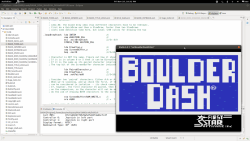
You can also configure your scripts as "User Defined Application". I do this for complex scenarios which create a complete disk image with multiple files therein.
@Ferris: "I've gone to a new workflow where I've written my own assembler in C#" - well, then, ehn, this is the wrong thread for you :-)
You can also configure your scripts as "User Defined Application". I do this for complex scenarios which create a complete disk image with multiple files therein.
@Ferris: "I've gone to a new workflow where I've written my own assembler in C#" - well, then, ehn, this is the wrong thread for you :-)
WUDSN IDE Tutorial 8: New features in version 1.6.2
Every compiler on every platform, new platforms (Atari7800, NES) and compilers (KickAss), include file handling, navigation for compound labels, multiple help files and instructions in online help.
WUDSN IDE Tutorial 9: Source Level Debugging
Did you ever dream of source level breakpoints in assembler? Here they are!
I intentionally did not try to implement a debugging visually within Eclipse. Instead the IDE brings the compiler and the emulator together, so the emulator can become the "Debugging Perspective". With turnaround times of 1-2 seconds you really don't need anything else.
Every compiler on every platform, new platforms (Atari7800, NES) and compilers (KickAss), include file handling, navigation for compound labels, multiple help files and instructions in online help.
WUDSN IDE Tutorial 9: Source Level Debugging
Did you ever dream of source level breakpoints in assembler? Here they are!
I intentionally did not try to implement a debugging visually within Eclipse. Instead the IDE brings the compiler and the emulator together, so the emulator can become the "Debugging Perspective". With turnaround times of 1-2 seconds you really don't need anything else.
2013-12-18 New zero installation distribution of WUDSN IDE
One of the reasons why I created WUDSN IDE is to make it easy for people to (re)start working with 6502 assembly for their beloved Atari, C64 or other machine. As you could already see in the Tutorial part 1, the installation from scratch is easy and fast.
To make your initial steps even easier, I now provide also a ready to run zero installation distribution a wudsn-ide-win64.zip for Windows 64 bit operating systems. It contains the Eclipse Platform, the latest stable version of WUDSN IDE plugin, all supported compilers and an emulator for each supported platform. All paths to folders, compilers and emulators are pre-configured.
Unpack the content of this archive to the directory "C:\jac\wudsn" and click the "WUDSN IDE" link - That's all.
Eclipse will open with the predefined workspace that contains "Hello World" examples for different platforms. You can adapt, compile and run the examples with a single click.

One of the reasons why I created WUDSN IDE is to make it easy for people to (re)start working with 6502 assembly for their beloved Atari, C64 or other machine. As you could already see in the Tutorial part 1, the installation from scratch is easy and fast.
To make your initial steps even easier, I now provide also a ready to run zero installation distribution a wudsn-ide-win64.zip for Windows 64 bit operating systems. It contains the Eclipse Platform, the latest stable version of WUDSN IDE plugin, all supported compilers and an emulator for each supported platform. All paths to folders, compilers and emulators are pre-configured.
Unpack the content of this archive to the directory "C:\jac\wudsn" and click the "WUDSN IDE" link - That's all.
Eclipse will open with the predefined workspace that contains "Hello World" examples for different platforms. You can adapt, compile and run the examples with a single click.
I think I told you this when we talked at Revision, but I really think your work here is a great example of ways the demoscene is progressing. We are still keeping the operative constraint, the hardware, fixed, but develop tools all around the original hardware in order to make it both easier and more fun to create something great.
While I don't understand the finer aspects of the technical side, I still feel secure enough of the value of this, to commend you :)
While I don't understand the finer aspects of the technical side, I still feel secure enough of the value of this, to commend you :)

I'm probably going to keep using my own SDK for the Oric stuff, but it looks like you did a pretty good job :)

At the end of January I delivered a 35 minutes presentation about the VCS, its history and architecture and how to code for it using WUDSN IDE.
Programming the Atari 2600 Video Computer System (Live)
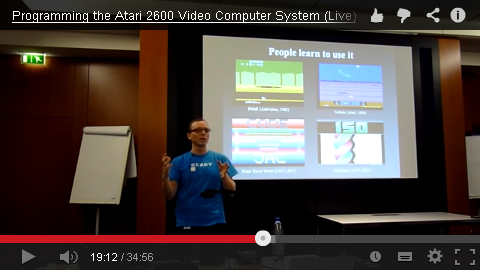
Especially the live coding part was very appreciated by the audience. Changing a single line of code and seeing immediately what happens brings you as close a possible to the machine. The recording of the presentation is now available on my youtube channel. The slides (PDF) and the sources can be downloaded from here. I recommend you open the slides in parallel, so you can read the content and code correctly. Thanks to Julien for the event and SvOlli for the slide templates.
Programming the Atari 2600 Video Computer System (Live)
Especially the live coding part was very appreciated by the audience. Changing a single line of code and seeing immediately what happens brings you as close a possible to the machine. The recording of the presentation is now available on my youtube channel. The slides (PDF) and the sources can be downloaded from here. I recommend you open the slides in parallel, so you can read the content and code correctly. Thanks to Julien for the event and SvOlli for the slide templates.
dope shit!

Good stuff JAC! - always good to have an entry-level introduction in video form to 8-bit programming without relying on misinformation or antiquated documents
